Tile Roof Underlayment Replacement Cost: Materials Compared
Under shingles, underlayment is a supporting actor. Under tile, it *is* the roof — the tile is a beautiful, durable rain screen, and the membrane beneath it does the waterproofing. So when we wrote the general [underlayment replacement cost guide](/guides/roof-underlayment-replacement-cost), the tile-specific question kept deserving its own page: which membrane, at what cost, lasting how long, under Phoenix tile?
Under shingles, underlayment is a supporting actor. Under tile, it is the roof — the tile is a beautiful, durable rain screen, and the membrane beneath it does the waterproofing. So when we wrote the general underlayment replacement cost guide, the tile-specific question kept deserving its own page: which membrane, at what cost, lasting how long, under Phoenix tile?
The tile underlayment options, compared
| Underlayment type | Material cost per sq ft | Service life under tile | Best for |
|---|---|---|---|
| Standard felt, 15# (single ply) | $0.75–$1.50 | 15–20 years | Budget jobs; roofs being prepped for sale |
| Heavy felt, 30# (single or double ply) | $1.00–$2.00 | 20–25 years | The traditional Southwest tile spec |
| Synthetic underlayment | $1.50–$3.00 | 25–40 years | Most re-roofs — the modern value pick |
| High-temp modified bitumen | $2.00–$4.00 | 30–50 years | Premium spec; low slopes; “do it once” owners |
Material figures compiled from published roofing cost references (HomeCostify / Best Roofing Estimates industry guides); installed totals are in the main underlayment cost guide.
Read the table the way a roofer does: the whole spread between the cheapest and the best membrane is about $3 per square foot of material — on a 2,000 sq ft roof, roughly $1,500–$2,500 of a job whose labor (lifting and relaying every tile) costs several times that. The lifespan spread is 15 years versus 40. That asymmetry is the entire argument.
Why heat rating matters more than brand
A tile roof in Phoenix is a solar oven with the membrane as the filling. Roof surface temperatures pass 160°F, and the underlayment sits just under that, cycling daily. Standard felt’s asphalt oxidizes and embrittles in that environment — the failure mode behind the current Valley-wide wave of 20-year-old leaking tile roofs (we explain the mechanism in how long a tile roof lasts).
High-temperature-rated membranes are formulated to resist exactly this: they stay flexible at tile-field temperatures and don’t bleed or crack at the laps. When you compare bids, the spec line to hunt for is a stated high-temp rating and a tile application approval — not a brand name.
Felt vs synthetic vs modified bitumen — the honest trade-offs
Felt (15# / 30#). The original, and fine at its job for its rated life. Cheap, forgiving to install, and what most 1995–2010 Valley homes already have. Its problem is purely the calendar: in this climate it is a 15–25 year product being asked to protect a 50-year tile. If your roof was built with felt, it will need this job again.
Synthetic. Woven polypropylene/polyethylene membranes: lighter, far more tear-resistant (matters when thousands of tiles are stacked and relaid over it), and rated 25–40 years under tile. The mid-price option and, for most owners, the right default.
High-temp modified bitumen. The premium play — a rubberized asphalt membrane, often self-adhered, rated for the highest temperatures and the longest life (30–50 years in industry references). Choose it for low-slope tile sections, complex roofs where a leak would be catastrophic, or if your honest plan is “never think about this again while I own this house.”
What about the battens, flashing and ridge?
A real underlayment job renews the whole hidden system, and bids should say so: new battens where the old ones are split or rotted (or a switch to a batten-less direct-deck spec where appropriate), new valley and wall flashing metal, new pipe and vent flashings, and re-bedded or mechanically-fastened ridge. Reusing 25-year-old flashing against a new 40-year membrane is false economy — the flashing becomes the new weakest layer. If a bid’s price looks magically low, this section is usually where the money was saved. Our hiring questions guide lists exactly what to ask.
Partial replacement: the south-slope strategy
Membranes don’t age evenly. South and west slopes take the brutal sun; north slopes can have a decade of life left when the south side is dust. A slope-by-slope approach — do the failed elevation now, budget the rest in 5–8 years — is legitimate and common, and per-slope pricing in the $900–$2,200 range (from the main cost guide) makes it financeable. The one caution: tile color. Relaying one slope with a batch of salvage tiles can leave a visible tone difference; a good roofer blends from the least visible slope.
The decision, in one paragraph
If this is your long-term home, buy the membrane you’d want to be thinking about in 2055: synthetic at minimum, modified bitumen if the budget stretches the extra few hundred. If you’re selling within five years, 30# felt is an honest, code-appropriate spec — disclose it and price accordingly. Either way, get the exact product named in the written bid, because “new underlayment” without a spec is how a 40-year promise turns into a 15-year layer. And if you’re still deciding whether your membrane is actually done, how often to replace underlayment walks the diagnosis.
What a lift-and-relay actually looks like, day by day
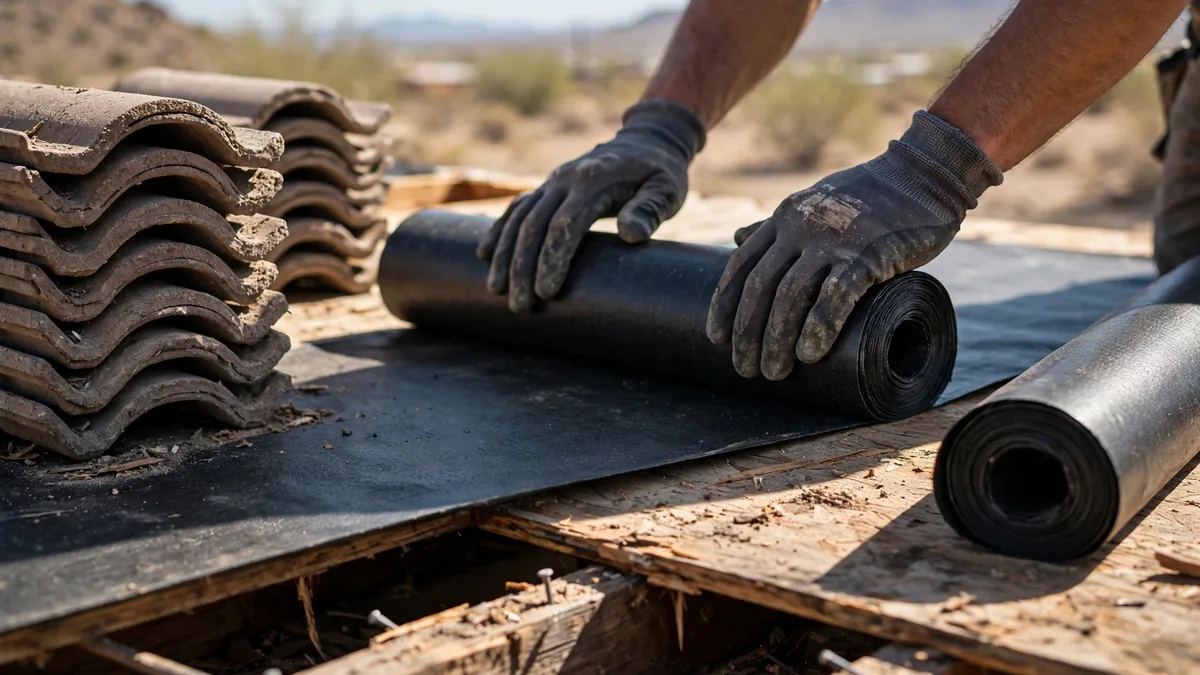
Day one is subtraction: crews strip tile slope by slope, stacking reusable tile on the roof in neat piles, and the old membrane comes off to expose the deck — the moment of truth for hidden rot, photographed and priced per the contract’s per-sheet clause. Day two is the new system: deck repairs if any, the membrane you’ve chosen rolled and lapped (or self-adhered, for modified bitumen), new flashing metal at every valley, wall and penetration, battens where the design uses them. Days two-to-three are the relay: your tiles go back on in their courses, breakage replaced from salvage, ridge system rebuilt. Living at home through it is normal — the house is dried-in nightly — but expect dawn starts, real noise, and a yard that is a workplace. The detail that separates craftsmen from crews: the tile comes off and goes back in order, so color blending across the field survives the surgery.
Dust, disposal and the neighborhood factor
Tile work is dusty and the old membrane — decades of baked felt — comes off in rolls that go straight to disposal (its line on your bid is real: weight is money at the landfill). In communities like Desert Ridge, where the roof is a designed element, the relay’s color blend matters as much as its waterproofing; a roofer who stages tile from multiple slopes to blend tones is solving a problem your HOA and your neighbors will otherwise solve for you in comments. Confirm in the bid: salvage sourcing for breakage, blending method, and what happens to leftover attic stock (it should stay with you — it’s your future repairs, pre-matched).
How do you verify the membrane in a bid is the membrane discussed?
Ask for three things in writing: the full product name, whether it is rated for high-temperature tile applications, and how many plies will be installed. “Synthetic underlayment” alone is not a specification — synthetics vary in weight, temperature rating, and expected life under tile, and the same is true of felt described only by weight. A product name lets you check the manufacturer’s tile approval yourself and confirms the crew cannot quietly substitute a lighter sheet on install day.
On the day work starts, the rolls or bundles arriving on site should match the name in the contract. That simple check does more for the outcome than any brand preference. If a substitution is proposed because of supply, get the replacement product’s rating and service life in writing before it goes down, not after the tile is back on top of it.
Which install details shorten an otherwise good membrane’s life?
Correct material can still be undermined by laps that run short, fasteners placed where tile movement will work on them, or an exposed membrane left in full sun for days between tear-off and relay. In Phoenix, an uncovered membrane can begin taking heat damage before it ever serves under tile. The sequence matters: tear off only what the crew can dry in and cover on schedule, and confirm that valleys and wall transitions receive the membrane detailing the product requires.
How we publish costs: every figure on this page is a range compiled from named third-party sources credited in the text (Angi, HomeAdvisor, the National Weather Service, the Arizona Registrar of Contractors and roofing-material references) — never a quote. Roofing prices move with material costs, roof size and access; the only number that matters for your house is a written bid from a licensed roofer.
Frequently asked questions
What is the best underlayment for a tile roof in Arizona?
For most Phoenix tile homes, a high-temperature synthetic or a modified-bitumen membrane rated for tile in hot climates is the best value: 30–40+ years of service life for a modest premium over felt. Plain felt works, but it is the layer that failed on the current generation of 20-year-old Valley roofs — replacing it with the same spec restarts the same clock.
Why does underlayment cost more under tile than under shingles?
Two reasons: tile systems need heavier, heat-rated membranes (tile fields run hotter and the membrane must survive decades under a heavy, sun-baked load), and the labor is different — every tile must be lifted, stacked and relaid by hand. The membrane itself is a small share; handling the tile is the bill.
What is a 'double layer' underlayment and is it worth it?
Two plies of felt (or felt plus a base sheet) installed with staggered laps — the traditional tile spec in the Southwest. It roughly doubles material cost but adds real redundancy: a crack in the top ply doesn't reach the deck. On low-slope tile sections it's close to mandatory; on standard pitches a single ply of premium synthetic can match it.
Can you replace underlayment on just part of a tile roof?
Yes — one slope or one elevation at a time is common, especially the south and west slopes that bake hardest. It costs more per square foot than doing the whole roof at once (setup and tile handling repeat), but it spreads the spend across years and targets the membrane that is actually failing.
Does the tile warranty require a specific underlayment?
Tile manufacturers typically require underlayment that meets ASTM standards for tile applications and, in hot climates, a high-temperature rating. Your roofer should name the exact product in the bid — if a bid just says 'new underlayment,' ask which one, because the lifespan difference between the cheapest and best option is measured in decades.