How Often Should You Replace Roof Underlayment in Arizona?
Every tile roof in Phoenix runs on a hidden calendar. The tile is fine — it will be fine for decades — but underneath it, the underlayment is aging on a schedule set by the membrane type and the desert sun. This page is that schedule, plus how to figure out where your roof sits on it.
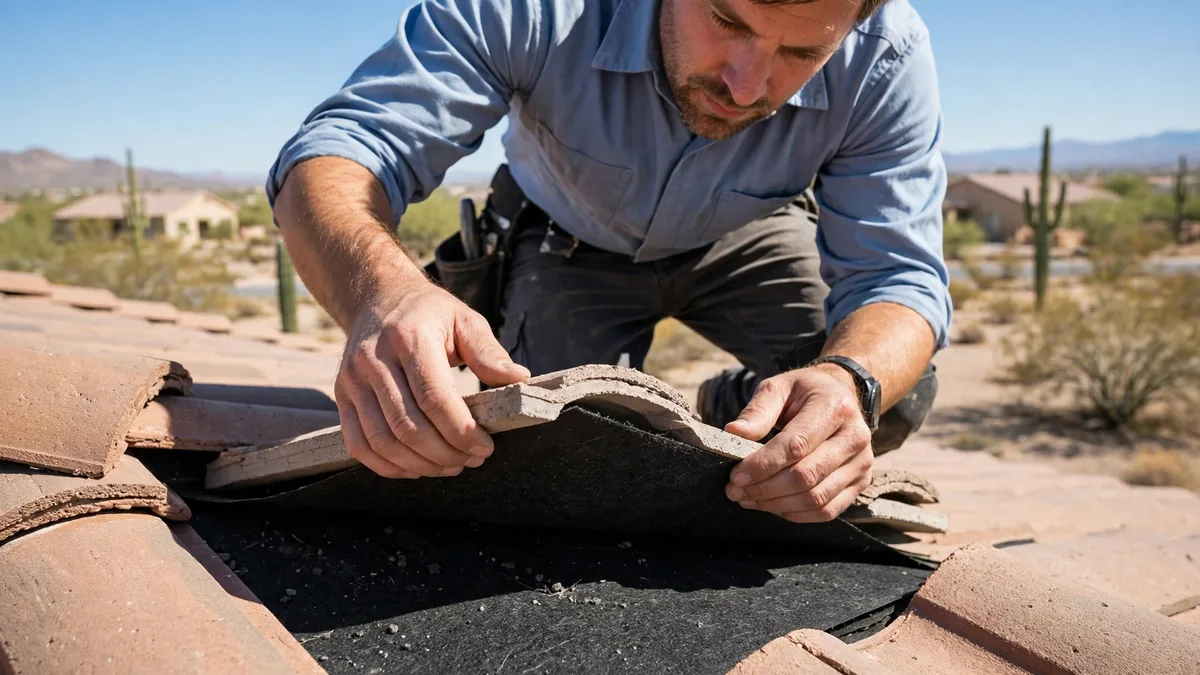
Every tile roof in Phoenix runs on a hidden calendar. The tile is fine — it will be fine for decades — but underneath it, the underlayment is aging on a schedule set by the membrane type and the desert sun. This page is that schedule, plus how to figure out where your roof sits on it.
The underlayment lifespan table (Arizona)
| Membrane under tile | Expected Arizona service life | Status of typical installs |
|---|---|---|
| 15# felt, single ply | 15–20 years | Common in 1990s budget builds — failing now or failed |
| 30# felt, single/double ply | 20–25 years | The 1995–2010 standard — the current replacement wave |
| Synthetic underlayment | 25–40 years | Modern default; roofs done after ~2015 |
| High-temp modified bitumen | 30–50 years | Premium spec; next due dates are decades out |
Life ranges from industry underlayment references; material costs and full comparisons in the tile underlayment cost guide.
The build-year shortcut
If you know nothing else, know your home’s build year and its re-roof history. For the great Phoenix build-out — Desert Ridge, north Phoenix, Peoria, Gilbert, Chandler, roughly 1995–2005 — original felt underlayment is now 20–30 years old. In that cohort, “never been replaced” means “due,” full stop. The 2005–2015 cohort is in the inspection zone: the membrane has 15–20 years on it, condition varies by slope and spec, and a professional look (average ≈ $365, inspection cost guide) converts guessing into a date. Post-2015 roofs with synthetic membranes are on a longer clock — log the install date and the product name from your paperwork; that piece of paper is worth money at resale.
Why the calendar is shorter here than anywhere else
Underlayment aging is heat chemistry: asphalt oxidizes, oils leave, the sheet goes brittle. Phoenix roof cavities deliver the highest sustained temperatures in US residential roofing — surface temperatures above 160°F, daily thermal cycling of 40+ degrees, and monsoon humidity spikes into a baked membrane. The same felt that might give 30 years in a mild climate gives 20–25 here, exactly parallel to why Arizona shingles live 15–20 years instead of 25–30 (shingle guide). Any roofer quoting you national-average lifespans for a Phoenix roof is working from the wrong map.
Symptoms override the calendar
Age is the plan; symptoms are the truth. Move your replacement date up if you see: leaks in hard, wind-driven rain only; staining at ceilings below valleys or wall joints; membrane visible at an eave that’s curled, cracked or crumbling to the touch; or felt debris washing into gutters. Our warning signs guide covers these per roof type. Conversely, if an inspector lifts tile and finds flexible, intact membrane at 22 years — some roofs do run long, especially double-ply 30# on shaded slopes — a monitored extension with a re-check in 2–3 years is a legitimate, documented decision.
Sequencing the job when it’s time
When the date arrives, the move set is: inspect and map by slope → decide whole-roof vs slope-by-slope → choose the membrane that sets the next date (this is the one place not to economize; see the comparison table in the underlayment cost guide) → schedule in the dry season with the pre-monsoon calendar in mind → keep the paperwork (product, date, warranty) with the house documents. Do that, and the question this page answers never has to be asked about your roof in a panic: the next date is already written down — roughly 2055, if you bought the good membrane.
What happens if you run old underlayment five years too long
The membrane doesn’t fail all at once — it fails at the laps, fastener lines and valleys first, which produces the classic Phoenix pattern: small leaks in hard rain only, a stain that grows slowly, deck edges getting damp a few storms a year. The cost of those extra years is not the leak itself; it’s what the water reaches. Plywood decking that wets and dries for five seasons delaminates and rots, turning a membrane-only job into a membrane-plus-decking job at per-sheet prices. Fascia and eave framing join in. In bad cases, moisture reaches insulation and drywall and the project acquires an interior-repair chapter. The arithmetic is asymmetric: replacing on time costs the standard job (average ≈ $3,400); replacing late costs the standard job plus decking, plus interior repairs, plus the emergency timing premium if the failure announces itself mid-monsoon. “Getting your money’s worth” out of the last years of a membrane is the most expensive strategy in tile roofing.
How an inspector maps membrane condition slope by slope
The professional version of this decision is a map, not a verdict. The inspector samples the membrane at accessible points (eaves, cutbacks, a lifted tile or two at a valley), tests flexibility — aged felt snaps or cracks when flexed; healthy membrane bends — and records condition per slope. South and west slopes commonly rate a full stage worse than north. That map converts directly into a plan: replace the failed slopes this winter, schedule the rest in 3–5 years, or do the whole roof once while the crew and the tile handling are already paid for (whole-roof economics usually win once two or more slopes are due). Ask for this map in writing with photos; it’s the document that turns an inspection fee into a multi-year capital plan instead of an opinion.
What should a monitoring plan look like between inspections?
Once you know the membrane’s age and type, replacement does not have to be a single yes-or-no decision made in one visit. A monitored roof has a rhythm: a professional look when the membrane enters the last third of its expected life, a re-check at an interval the inspector sets — commonly two to three years on a sound but aging felt roof — and an attic and ceiling check after each monsoon season in between.
Keep each visit’s findings in the same folder, dated and with photos from the same eaves and valleys. Flexibility that was good at one visit and noticeably stiffer at the next is information. So is a slope that has not changed at all. That record is what separates a deliberate extension — membrane still intact, documented, re-checked on schedule — from simply waiting and hoping. If you sell in the meantime, the sequence of reports also shows a buyer that the roof’s age was being managed, not ignored.
How do you budget for a date that is years away?
Treat the replacement date the way you would any other known major system date in the house. First, establish the window: membrane type, install year, and the slope condition from an inspection map. A roof with one slope near the end and three sound slopes has a different budget shape than a roof where all slopes are due together.
Second, decide the sequencing early. If two or more slopes will come due within a few years of each other, pricing the whole roof once is usually the cleaner plan, because tile handling, setup, and flashing renewal are paid for once rather than repeated. If only the south slope is failing, a partial job in the $900–$2,200 range can be the correct first step, with the remaining slopes carried as a dated future item rather than a surprise.
Third, choose the next membrane before you need it. The choice between felt, synthetic, and high-temperature modified bitumen determines whether the following date is roughly 20 years out or 30–40 years out — see the comparison in tile roof underlayment replacement cost and the full job pricing in roof underlayment replacement cost. Deciding that specification in the dry season, with bids in hand, is consistently cheaper and calmer than deciding it after a stain appears.
What changes for a home you do not live in year-round?
Rental and seasonal homes fail differently, not because their membranes age faster, but because leaks are noticed later. A stain that a resident would catch after the first driven rain can sit through an entire monsoon season in an empty house, wetting deck and insulation repeatedly.
For those properties, shorten the decision loop: inspect closer to the end of the membrane’s expected life rather than beyond it, keep attic checks on the calendar between tenants or visits, and consider acting on age and condition before symptoms appear. The calendar in this guide matters more, not less, when no one is home to report the first sign that it has run out.
How we publish costs: every figure on this page is a range compiled from named third-party sources credited in the text (Angi, HomeAdvisor, the National Weather Service, the Arizona Registrar of Contractors and roofing-material references) — never a quote. Roofing prices move with material costs, roof size and access; the only number that matters for your house is a written bid from a licensed roofer.
Frequently asked questions
Can underlayment last 30 years in Arizona?
The premium products can — high-temperature synthetics and modified bitumen membranes are rated in the 30–40+ year range under tile. Standard felt cannot: the roofs failing across Phoenix right now are overwhelmingly 20–25-year-old felt installations. The answer depends entirely on which membrane your builder or last roofer chose, which is why the spec matters so much at replacement time.
How can I find out when my underlayment was last replaced?
Three sources: the home's build year (default assumption: original unless proven otherwise), City of Phoenix/Scottsdale permit records for re-roofing work, and the seller's disclosure from when you bought. If none shows an underlayment job, assume original. A roofer can also lift a few tiles at an eave or valley during an inspection and read the membrane's condition directly.
Should I replace underlayment before it leaks, or wait?
Before, if the age and condition say it's near the end — planned dry-season replacement (average ≈ $3,400, Angi) is cheaper than the same job bought in an emergency, and every leak season the membrane fails costs deck rot and interior damage on top. Waiting is rational only when an inspector confirms the membrane is still flexible and intact, not merely because it hasn't leaked yet.
Does underlayment wear out evenly across the roof?
No. South and west slopes bake hardest and fail first; shaded north slopes can have years of life left. That's why partial, slope-by-slope replacement is a legitimate strategy — an inspector can map the roof slope by slope and sequence the work across a few years instead of billing the whole roof at once.
What are the signs underlayment replacement is overdue?
Leaks that appear in wind-driven rain but not gentle rain; leaks at valleys and roof-to-wall joints; visible brittle or curled membrane at eaves and tile cutbacks; gritty black felt debris in gutters; and any tile roof past 25 years that has never had the job done. The full symptom list for every roof type is on our warning-signs page.