Does Insurance Cover Monsoon Roof Damage in Arizona?
Every July, the same argument plays out on Phoenix roofs: the homeowner says "the storm did it," the adjuster says "age did it," and both are holding photos of the same cracked underlayment. Here's how Arizona monsoon claims actually work, so you can run yours with your eyes open.
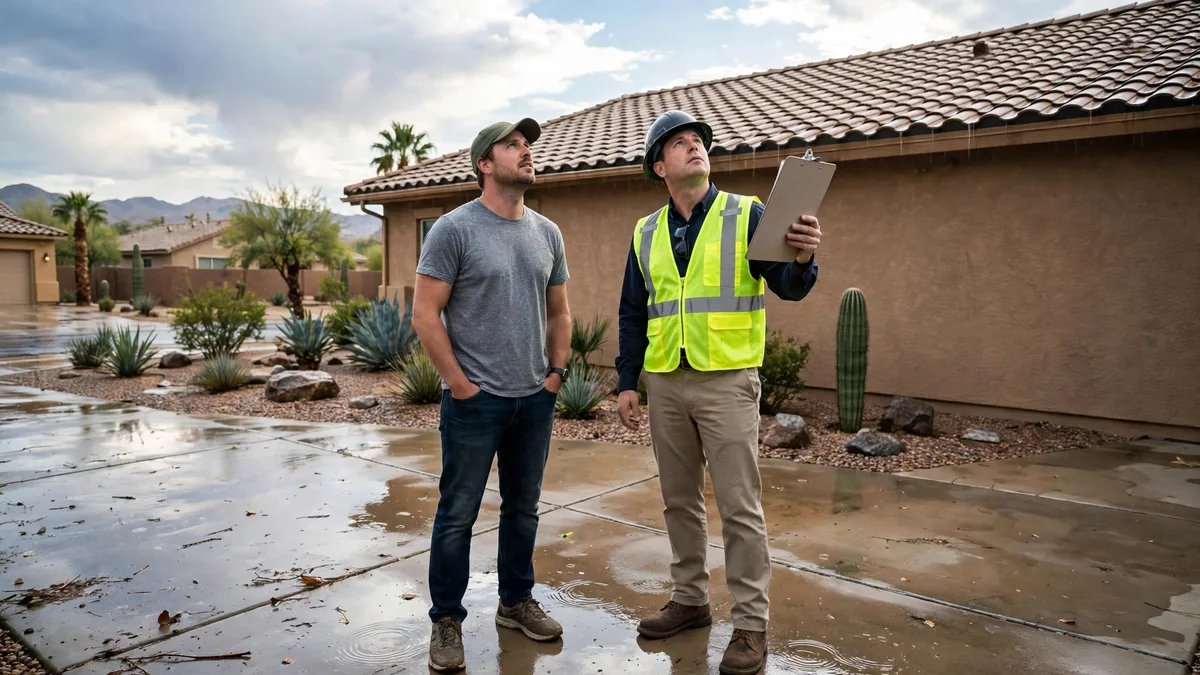
Every July, the same argument plays out on Phoenix roofs: the homeowner says “the storm did it,” the adjuster says “age did it,” and both are holding photos of the same cracked underlayment. Here’s how Arizona monsoon claims actually work, so you can run yours with your eyes open.
What does a standard Arizona policy cover on a roof?
| Scenario | Typically covered? | Why |
|---|---|---|
| Wind lifts tiles/shingles off in a storm | Yes | Sudden, accidental wind damage |
| Tree or large limb punctures the roof in a storm | Yes | Sudden impact; includes resulting interior water damage |
| Rain enters through a storm-created opening | Yes | The opening is the covered event |
| Rain leaks through worn-out, 20+ year underlayment | No | Wear and tear / maintenance exclusion |
| Mortar and flashing deteriorate over years | No | Gradual deterioration exclusion |
| The storm “revealed” pre-existing rot in the deck | Mostly no | Rot is pre-existing; only the storm-caused portion is argued |
| Ceiling/Interior damage from a covered leak | Yes | Follows the covered opening |
The pattern from our monsoon damage guide holds in claims too: storms are sudden; Phoenix roof failures are usually gradual. Policies pay for sudden.
The two numbers that decide everything
Your roof settlement type. Find the words “replacement cost” or “actual cash value” in the roof/wind section of your policy — or a “roof payment schedule” that pays a percentage by roof age. On a young roof the difference is small; on a 20-year-old tile roof (where the claim is really about the underlayment system under it), ACV depreciation is where claims go to shrink.
Your wind deductible. Flat $1,000 deductibles are increasingly replaced in Arizona by 1–2% wind/hail deductibles. Do this math before dialing: (expected repair cost) minus (deductible) minus (depreciation, if ACV) = the check. If it’s near zero or negative, pay cash, keep your claims history clean, and read what the repair costs instead.
How to run a monsoon claim well
- Document before you clean up. Timestamped photos of displaced tiles, debris, interior stains; screenshots of the NWS storm report for your date and ZIP. Adjusters approve what they can verify.
- Mitigate, and keep receipts. Tarping and emergency dry-in are usually covered as reasonable mitigation — and failing to mitigate gives the carrier an argument about everything that got wetter afterward.
- Get a roofer’s written findings, line-itemed. Storm damage in one column, age findings in another. A roofer who blurs the two is either sloppy or building the denial for you.
- Meet the adjuster with your roofer present (a legitimate service) — but the contract you sign for repairs should be a normal repair contract at a stated price, never an open-ended claim assignment.
- If the denial is about classification, appeal with evidence. The storm-exposed vs storm-caused line is genuinely arguable when wind shifted tiles or drove rain into a specific detail. A public adjuster can make sense on a large claim; on a small one, their percentage eats the recovery.
The trap to avoid entirely
Post-storm Phoenix fills with door-knockers promising “a free roof through insurance” and offering to absorb your deductible. Absorbing a deductible means billing the carrier for money not spent — fraud, and Arizona regulators and carriers both pursue it. The other signature move is the assignment-of-benefits form presented as “just paperwork so we can talk to your insurer.” An AOB can transfer your claim rights wholesale. Licensed, established Valley roofers document, meet adjusters and write real contracts; they do not need your claim’s legal rights. Verify any of them at roc.az.gov in two minutes (more in our hiring questions guide).
If the answer is no — what then?
A denied age claim doesn’t change the roof: brittle underlayment still needs its lift-and-relay on a planned schedule, ideally in the dry season with three bids. The homeowners who come out best in monsoon season are the ones who treated the storm as a free inspection: fix the storm damage, price the age work honestly, and do the pre-monsoon checklist next spring so the next storm is weather, not a claim.
The evidence kit: what to hand an adjuster
Claims are decided on evidence density. Assemble, before the adjuster visit: timestamped photos of displaced or broken roofing and the debris field; interior photos with dates showing stain progression; the NWS storm report or local news record for the damaging date; any pre-storm documentation you have (a May inspection report is quietly the most powerful document in Arizona claims — it proves prior condition); your roofer’s line-item findings separating storm damage from age findings; and receipts for mitigation. Present it as one organized file. Adjusters are professionals processing hundreds of files; the homeowner whose evidence is complete gets the benefit of every legitimate doubt.
Public adjusters: when the math works
A public adjuster works for you (not the carrier) for a percentage of the recovery — which makes them rational on large, disputed claims and irrational on small ones. The sensible cases: a denied claim you believe misclassified storm damage as wear; a large loss (structural, multi-slope) where scope arguments are worth thousands; or a settlement whose depreciation math you can’t audit. Interview them like roofers: Arizona licensing, fee in writing, references on roof claims specifically. And remember the symmetric rule from the rest of this guide — anyone promising a guaranteed outcome on a claim is selling, in whichever direction they’re standing.
What does the claim timeline usually look like?
Most monsoon roof claims move in stages, and knowing the stages prevents misreading a slow week as a denial. After you report the loss, the carrier assigns a claim number and an adjuster, who schedules an inspection of the roof and any interior damage. In peak storm weeks that visit can take longer than in a quiet month, which is one reason mitigation and documentation should not wait for it.
The adjuster then produces an estimate for the covered scope. If your policy is replacement cost, payment commonly arrives in more than one part: an initial payment reflecting the depreciated value, with the remaining depreciation released after the covered work is completed and documented with invoices and photos. If your policy settles the roof on an actual cash value basis or an age-based schedule, there may be no second payment to recover — that difference is in the policy wording, not in how well the claim was filed.
Keep the claim number on every document you send, and keep copies of the estimate, the roofer’s scope, and the final invoice together. Disagreements later are almost always about whether a line item belongs to the storm scope, and the file that answers that question is the one built during these weeks, not reconstructed afterward.
How do you handle interior damage while the roof claim is open?
Interior damage follows the opening that caused it. If rain entered through a storm-created opening, the ceiling, insulation, and finishes damaged by that water are typically part of the same claim. If the entry point is classified as long-term wear, the interior damage that followed it is likely to be treated the same way.
Either way, do not repaint or close up a ceiling until the source above it has been identified and, ideally, repaired, and the materials have dried. Photograph the stain, its size, and any progression with dates before any cleanup, and keep receipts for mitigation such as drying or tarping. If the classification is disputed, the interior record matters: a stain that appears immediately after a dated storm, below a displaced tile or damaged flashing detail, tells a different story than gradual staining with no single storm attached to it. Your roofer’s written findings, separating storm damage from age findings, should describe the roof detail and the interior damage it corresponds to — see the documentation approach in monsoon roof damage and the repair scoping in monsoon roof damage repair.
How we publish costs: every figure on this page is a range compiled from named third-party sources credited in the text (Angi, HomeAdvisor, the National Weather Service, the Arizona Registrar of Contractors and roofing-material references) — never a quote. Roofing prices move with material costs, roof size and access; the only number that matters for your house is a written bid from a licensed roofer.
Frequently asked questions
Will insurance pay for a new roof after a monsoon storm?
Only if the storm actually destroyed the roof's function and the damage is documented as storm-caused — rare for a whole roof. Far more commonly, the carrier pays for the damaged section (a slope, the tiles the wind took, the ceiling below) and denies the age-related remainder. A full-roof payout generally requires storm damage across most of the roof on a roof that was otherwise sound.
What is the difference between ACV and replacement cost on a roof claim?
Replacement cost value (RCV) pays what the repair/replacement costs today (often in two installments: actual cash value first, the depreciation released after work is done). Actual cash value (ACV) pays today's cost minus depreciation for age and condition — on a 20-year-old roof that deduction can be half or more. Many Arizona policies switch roofs to ACV or a depreciation schedule once they pass 15–20 years, so read your policy's roof settlement section before assuming.
What is a wind/hail deductible in Arizona?
Many Valley policies carry a separate percentage deductible for wind and hail claims — commonly 1% or 2% of the home's insured value instead of the flat deductible. On a $450,000 insured home, 1% is $4,500: a $2,000 tile repair never reaches it. Knowing this number before you file is the whole ballgame — a filed-but-unpaid claim still sits in your claims history.
The adjuster said my leak is 'wear and tear.' Can that be right?
Often, yes — and it's the most common monsoon claim outcome in Phoenix. If wind drove rain through an opening the storm created, that's covered storm damage. If rain entered because 23-year-old underlayment finally cracked, carriers classify it as maintenance/wear and deny. The honest middle case — storm winds shifted tiles, exposing already-weak underlayment — gets negotiated line by line, which is why photos, a roofer's written findings and the storm date matter.
Should I let a roofer 'handle my claim' and waive my deductible?
Be careful. A roofer who documents damage and meets the adjuster is normal and helpful. A roofer who offers to waive or 'eat' your deductible is offering to inflate the invoice to the carrier — that's insurance fraud under Arizona law, and it puts you in the scheme. Likewise, never sign an assignment-of-benefits (AOB) form you don't fully understand; it can hand your claim rights to the contractor.