Monsoon Roof Damage Repair: What Fixes Cost in Phoenix
The storm is over, there's a stain on the ceiling or a pile of tile in the yard, and every roofing phone number in Phoenix is suddenly busy. This is the guide to what the fixes actually cost, so the busiest week of the roofing year doesn't become the most expensive one for you.
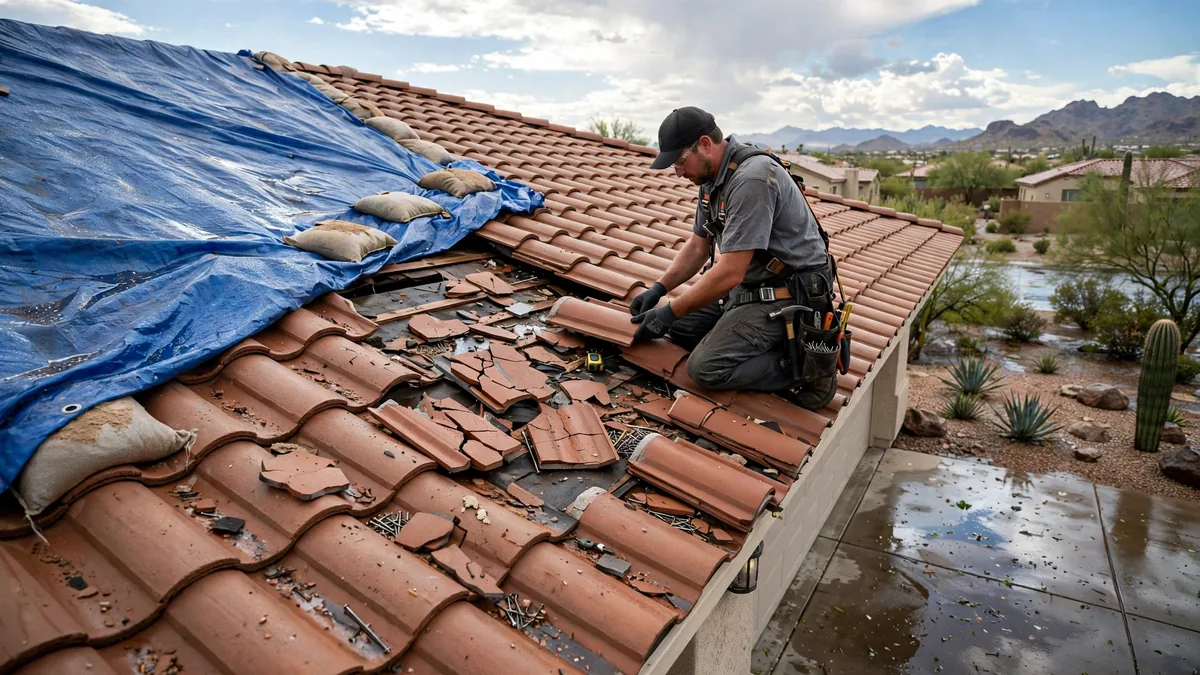
The storm is over, there’s a stain on the ceiling or a pile of tile in the yard, and every roofing phone number in Phoenix is suddenly busy. This is the guide to what the fixes actually cost, so the busiest week of the roofing year doesn’t become the most expensive one for you.
What do monsoon repairs cost in Phoenix?
| Repair type | Typical cost | What it covers |
|---|---|---|
| Emergency tarp / dry-in | $300–$800 | Temporary waterproofing of one area until permanent repair |
| A few broken/shifted tiles replaced | $300–$750 | Ground-accessible tile work, matched salvage tile |
| Ridge cap re-set and re-bedded (one run) | $400–$1,000 | Mortar/foam re-bedding or mechanical re-fastening |
| Flashing repair (wall, vent, chimney) | $350–$900 | The most common actual leak fix after storms |
| Small leak repair, one location | $300–$1,000 | Diagnosis plus tile/shingle patch and seal |
| Moderate section repair | $1,000–$5,000 | Partial underlayment replacement, a slope section, decking repair |
| Full slope underlayment (one elevation) | $900–$2,200 | When the membrane — not the storm — is the failure |
| Whole-roof repair range (Angi, Phoenix) | $175–$3,075 typical; avg $1,834 | Most storm repairs land inside this band |
Ranges compiled from Angi’s Phoenix roof repair data and Valley contractor repair guides; emergency work can add up to ~$300 (Angi).
How do you read a post-storm repair bid?
It should name the failure, not the weather. “Storm damage — $4,800” is not a diagnosis. A real bid says: 14 broken tiles on the south slope, ridge mortar failed along 20 feet, underlayment brittle and cracked at the valley — here are the photos, here’s the line-item fix for each. Storms are the messenger; the bid should be about the specific weaknesses the storm found (the pattern is explained in our monsoon damage guide).
Separate the three buckets. A good post-storm proposal separates: (1) emergency mitigation (tarp/dry-in), (2) storm-damage repair, and (3) age-and-wear work the storm exposed. Bucket 3 is real work, but it’s maintenance with a normal timeline and normal pricing — it should never be sold at emergency rates. This separation also matters for insurance: carriers pay for bucket 2, not bucket 3 (see the insurance guide).
Ask what breaks next. The useful question after any repair: “If another cell hits next week, where does this roof fail?” A roofer who can answer that — a tired north valley, foam coating at year nine, mortar on the west ridge — is selling you a roof, not a transaction.
When does a repair become a replacement conversation?
Three honest triggers:
- The underlayment is done everywhere. One slope’s membrane cracked is a repair; the same brittleness on every slope of a 23-year-old tile roof is a lift-and-relay project that the storm merely announced.
- The shingle field is shedding. Granule loss and curling across the whole roof (not just the storm’s corner) means the 15–20-year Arizona shingle clock ran out; patching buys months, not years. Compare against shingle replacement costs.
- The deck is wet in multiple places. Rotted decking in several areas says water has been traveling for a long time. At that point the repair-vs-replace math on our warning signs page applies.
The storm-week playbook, in order
- Document — photos of damage, debris, interior stains; save weather reports for your date (insurance loves a dated NWS storm report).
- Mitigate — tarp or emergency patch to stop water; keep the invoice.
- Decide insurance vs cash — run the deductible math before filing (guide linked above).
- Get two written, line-item bids for the permanent repair — even in storm week. The difference between the first and second number is often the price of this page.
- Verify the ROC license at roc.az.gov, especially with anyone who knocked on your door. Storm-chasing unlicensed crews are a Phoenix tradition; the Registrar’s lookup takes two minutes.
- Schedule the prevention version — once repaired, the same roof gets a pre-monsoon checklist pass next spring, so next July is a weather event, not a home-improvement emergency.
How long do storm repairs take in season?
Realistic storm-season timelines: emergency tarping within 24–48 hours from established local companies; the diagnostic visit within days; permanent repairs in 1–3 weeks depending on scope and the queue. Anyone promising a full permanent repair tomorrow in the worst week of July is either empty (ask why) or guessing. Use the wait productively: this is when you collect the second bid, run the insurance math and verify licenses — the calendar pressure drops the moment the tarp is on, because the emergency has been converted into a scheduled job. If a contractor’s queue is genuinely long, ask for the mitigation invoice separately so your insurance file shows reasonable action on your part.
Working with an insurer’s vendor list
If you file a claim, your carrier may offer a managed-repair or preferred-vendor program. These are legitimate options with a trade: the carrier’s vendor works to the carrier’s scope and rates, which keeps paperwork smooth but can compress the repair to the claim’s minimum. You are not required to use the vendor program — Arizona homeowners can choose their own licensed contractor and have the claim paid per its terms. The decision rule mirrors everything else on this site: accept the vendor if the written scope matches what your own roofer says the roof needs; choose your own roofer when the scopes diverge, and let the two scopes argue with evidence (photos, membrane condition) rather than adjectives.
What does a good permanent repair actually include?
A permanent repair rebuilds the detail that failed, rather than covering it. For broken or shifted tiles, that means lifting enough of the surrounding field to inspect the underlayment beneath, replacing damaged membrane in that area, and relaying sound tile with broken pieces replaced from matched stock. For ridge work, it means removing loose bedding, re-seating or re-fastening the caps, and renewing the bedding system — not pressing new mortar over a cap that is still loose.
Flashing repairs follow the same logic. The roofer should address the metal, its laps, and its seal at the wall, vent, or chimney, and check whether water was traveling from a point higher than the ceiling stain suggests. A patch of sealant over the visible crack can stop a drip temporarily, but it does not restore the flashing detail and it can hide the entry point from the next inspection. Ask what will be removed, what will be replaced, and what material will be used; a permanent repair has specific answers to all three.
How should you sequence repairs when a storm leaves several problems?
Start with anything admitting water, then anything that will admit water in the next cell, then age-related work the storm exposed. Active leak paths, open flashing, and missing tiles over living space come first. Loose ridge caps, cracked tiles with sound membrane beneath them, and clogged drainage come next, because the season is not over and each of those is one storm away from joining the first group.
That ordering also keeps the paperwork clean. Emergency mitigation, storm-damage repair, and planned age work are different buckets for pricing and for an insurance file — a point covered in does insurance cover monsoon roof damage in Arizona. A roofer who sequences the work in that order, and prices each bucket separately, is easier to compare against a second bid than one who bundles everything into a single storm total.
Why should the repair be re-checked after the next rain?
A repair is proven by weather, not by completion day. After the next significant rain, check the ceiling below the repair, look in the attic if you can do so safely in the morning, and confirm no new staining has appeared or expanded. Mark the edge of any existing stain in pencil with the date beforehand; growth past the line is a clear signal to call the roofer back while the job is fresh.
Keep the repair invoice, the before-and-after photos, and that dated check together. That small file confirms whether the fix held, supports any warranty conversation, and becomes part of the roof’s condition record for the next pre-monsoon inspection — and for answering the questions in questions to ask a Phoenix roofer the next time you hire for the roof.
How we publish costs: every figure on this page is a range compiled from named third-party sources credited in the text (Angi, HomeAdvisor, the National Weather Service, the Arizona Registrar of Contractors and roofing-material references) — never a quote. Roofing prices move with material costs, roof size and access; the only number that matters for your house is a written bid from a licensed roofer.
Frequently asked questions
How fast do I need to repair monsoon damage?
Stop active water entry immediately (tarp or emergency patch), then schedule the real repair within days-to-weeks. The urgency is about the next storm cell, not this one: an open leak path plus one more monsoon rain turns a $600 tile-and-flashing repair into ceiling, insulation and deck damage. Document first with photos, mitigate second, and let the permanent repair be a planned job, not a panic purchase.
What does emergency roof repair cost in Phoenix?
Angi's Phoenix data shows emergency repairs can cost up to about $300 more than the same repair scheduled normally, on top of the repair itself ($175–$3,075 normal range, $1,834 average). Tarping a section typically sits at the lower end. If an 'emergency' quote is thousands above the scheduled range, get it in writing and get a second number — storm weeks attract storm pricing.
My roofer says the storm means I need a whole new roof. True?
Usually not. Storms damage sections, details and accessories — tiles, ridge caps, flashing, a slope of shingles — far more often than they destroy a roofing system. Full replacement is the right call when the roof was already at end of life (brittle 20-year underlayment, a shingle field losing granules everywhere) and the storm exposed it. Ask what specifically failed, ask for photos, and read our signs-you-need-a-new-roof guide; if every answer is about age rather than storm damage, price it as an age project with three bids, not as an emergency.
Does repairing it myself void anything?
DIY tile swaps and sealant smears are the two classic Phoenix mistakes. Sealant over a leak path usually traps water and hides the real entry point, and walking tile without technique breaks more than it fixes. Small ground-level jobs — clearing gutters, documenting damage — are safe DIY. Anything involving lifting tile, flashing or underlayment belongs to a licensed roofer, and botched DIY repairs can complicate an insurance claim.
Should I file an insurance claim for the repair?
If the damage is storm-caused and the total plausibly exceeds your deductible (often 1–2% of home value on wind/hail endorsements in Arizona — $4,000–$8,000 on many Valley homes), a claim can make sense. If the repair is $800 and your deductible is $5,000, it's a cash job and a claim only adds a claims-history record. Our insurance guide walks the math before you call.