Foam Roof Cost in Phoenix: New SPF, Recoats & the Real Math
If your Phoenix home has a flat or low-slope section — a patio roof, a ranch-style main roof, an addition — there's a good chance it's foam, or should be. Spray polyurethane foam (SPF) is the desert's flat-roof default for good reasons, and its cost story is unlike any other roof: a moderate installation price, then a maintenance rhythm instead of a replacement cliff.
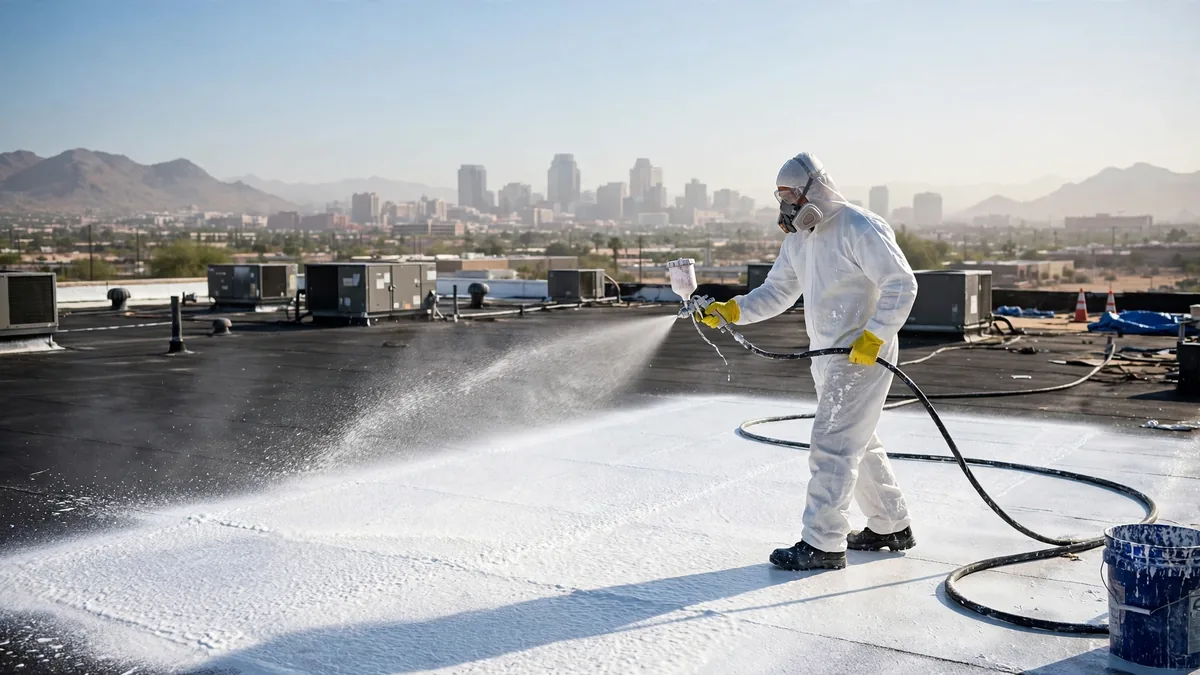
If your Phoenix home has a flat or low-slope section — a patio roof, a ranch-style main roof, an addition — there’s a good chance it’s foam, or should be. Spray polyurethane foam (SPF) is the desert’s flat-roof default for good reasons, and its cost story is unlike any other roof: a moderate installation price, then a maintenance rhythm instead of a replacement cliff.
What does a foam roof cost in Phoenix?
| Job | Cost | Arizona/Phoenix notes |
|---|---|---|
| New SPF system (≈1″ foam + coating) | $5–$9 per sq ft | AZ average ≈ $5.50/sq ft |
| Example: 1,200 sq ft roof, new system | ≈ $6,300 | At the AZ average rate |
| Recoat (every 5–10 years) | ≈ $2–$6 per sq ft | Coating type drives price (acrylic < silicone) |
| Localized cut-out & patch, re-coated | $400–$1,200 | Bird damage, punctures, blister repair |
| Tear-off of failed old system (add-on) | Project-priced | Required when old roof is wet/delaminated |
New-system ranges from published SPF cost references (Homewyse/HomeCostify-class guides) and Arizona foam contractor pricing; recoat ranges compiled from national SPF maintenance pricing.
What are you buying in a new SPF system?
A new foam roof is layers, applied in a day or two on most homes: the deck is prepared (old roof removed or prepped), SPF is sprayed to thickness (1 inch is the standard spec; foam’s closed-cell structure is both roof and insulation at R-6.5+ per inch), and an elastomeric coating — acrylic or silicone — is applied over it as the UV and weather shield. The coating is not paint; it’s the roof’s renewable skin, and its product name and applied thickness belong in your bid in writing.
The insulation line deserves emphasis in Phoenix: a foam roof over a flat section can measurably cut the heat load on the rooms below compared to a dark built-up roof. On west-side patio roofs and additions, owners notice it in the first summer electric bill.
The recoat cycle: the whole economics of foam
Every 5–10 years (climate and coating dependent), the coating is renewed: the roof is washed, damage is cut out and patched, and new coating goes down. Skip a cycle and the sequence runs the other way — coating cracks and thins, UV chews the foam surface (“sugaring”), birds peck the softened foam, ponding areas (from our monsoon guide — clogged scuppers are foam’s enemy) sit water on the wounds. A neglected foam roof can go from recoatable to re-foam in one skipped cycle, which turns a $2–$6/sq ft maintenance event into a $5–$9/sq ft project. The maintenance calendar puts recoats on the same schedule as everything else.
Decision rule for a roof you’re evaluating: coating intact and foam sound → recoat. Coating failed but foam core dry and sound → patch + recoat. Foam waterlogged, delaminated or mechanically destroyed → tear off and re-foam. A contractor who recommends re-foaming a recoatable roof is upselling; one who recoats over wet foam is burying your problem. Core samples settle arguments — ask for one.
Foam inside the whole-roof budget
Foam sections rarely live alone in Phoenix: the classic Valley roof is tile pitched sections plus a foam flat (patio, garage, addition). Budget them as two systems on two clocks — tile underlayment at 20–25 years (cost guide), foam recoats at 5–10 — and the whole roof’s lifetime cost becomes predictable instead of episodic. Compare against full-roof figures in the Phoenix replacement guide, and get any foam bid normalized (inches, coating, tear-off, warranty) using the roofer questions before comparing prices.
Ponding water: foam’s one true enemy
Foam itself is waterproof — closed-cell SPF doesn’t absorb water in any meaningful amount. Its vulnerability is geometric: flat roofs pond, and ponded water is patient. It sits on coating micro-cracks, exploits every peck and puncture, and adds weight exactly where a sagging deck already holds it. The standards conversation starts at 48 hours: water still standing two days after rain means the drainage design (slope, scuppers, crickets) needs correction, not just coating. At recoat time, a good contractor evaluates ponding areas explicitly — building up low spots with foam or tapered material is a recoat-scope line item worth paying for, because coating alone cannot fix a birdbath. Keep scuppers and drains physically clear year-round (the maintenance calendar puts this on the May and October passes); on foam, drainage maintenance is roof maintenance.
Foam and rooftop solar in Phoenix
Foam roofs and solar arrays coexist all over the Valley, with two coordination rules. First, sequence: if a recoat is due within a couple of years, do it before panels go on — removing an array to recoat underneath costs far more than the schedule shuffle. Second, mounting: racking penetrations through foam must be flashed and coated by the roofer’s method, not just sealed by the installer, and someone must own the warranty line where the two trades meet (get it in writing — our warranty guide explains why the paperwork decides). Walkways to the array should be coated with a tougher walk-pad system so service visits don’t grind the field coating away. Handle those three and foam under solar performs exactly as well as foam under open sky — which, on a Phoenix flat roof, is the benchmark everything else is measured against.
What installation day looks like — and what to verify while it happens
A new SPF system goes down fast, which makes the preparation the part worth watching. Before any foam is sprayed, the existing surface — old roof prepped in place, or bare deck after tear-off — should be clean, dry, and sound; foam sprayed over a damp or delaminating surface inherits every problem underneath it. The foam itself is applied in passes that build to the specified thickness, about 1 inch as the standard spec, and it should rise evenly, including the build-up at drains and scuppers where slope is created. The coating follows once the foam has cured, applied to the dry-film thickness named in your bid.
Two verifications are cheap on the day and expensive later. First, thickness: a contractor confident in the work will not object to spot checks of foam depth and a conversation about how coating thickness was measured, because both numbers are the difference between the $5–$9 per sq ft system you bought and a thinner one wearing the same invoice. Second, edges and penetrations: foam is self-flashing, but parapet bases, vent stacks, and equipment curbs are where rushed work shows first, so walk those details with the foreman before the crew leaves rather than discovering them at the first monsoon rain. Photograph the finished roof the same day — those images become the baseline every future recoat bid is judged against.
Choosing between acrylic and silicone coating
The recoat decision you will make every 5–10 years comes down largely to coating chemistry, and the published $2–$6 per sq ft recoat range maps onto it: acrylic systems sit at the lower end, silicone at the top. The practical dividing line is water. On a foam section that drains cleanly and dries between rains, acrylic’s lower cost and easy future recoating make it the sensible default. On a section with known ponding — water that stands past the 48-hour mark after rain — silicone earns its premium, because it tolerates standing water without breaking down the way acrylic can over repeated ponding cycles.
What not to do is choose on price alone without naming the ponding situation: the cheapest recoat on a ponding roof is often the one that has to be redone soonest, quietly converting a $2–$6 maintenance event into two. Get the coating product, its dry-film thickness, and the reason it suits your roof’s drainage written into the bid. A contractor who asks about your ponding areas before recommending a coating is doing the job in the right order; one who quotes a coating without ever mentioning drainage is quoting from a price sheet, not from your roof.
The 25-year cost picture, using only published ranges
Foam’s economics are easiest to see across one ownership span. Start with a 1,200 sq ft flat roof at the Arizona average of about $5.50 per sq ft — roughly $6,300 for the new system. Kept on schedule, that roof then asks for recoats at $2–$6 per sq ft every 5–10 years: on the same 1,200 sq ft, each recoat event is a four-figure job, and over 25 years you might buy two or three of them, with the foam core — and its insulation value — still in service underneath. Compare that rhythm with the alternative most owners fear: neglecting the coating until the foam itself is UV-damaged and waterlogged, at which point the decision collapses to tear-off and a new $5–$9 per sq ft system, plus disposal. The lifetime math of foam is therefore less about the installation price than about which of those two patterns your maintenance follows — a point worth weighing with the broader figures in the Phoenix roof replacement cost guide before committing to any flat-roof system.
How we publish costs: every figure on this page is a range compiled from named third-party sources credited in the text (Angi, HomeAdvisor, the National Weather Service, the Arizona Registrar of Contractors and roofing-material references) — never a quote. Roofing prices move with material costs, roof size and access; the only number that matters for your house is a written bid from a licensed roofer.
Frequently asked questions
How long does a foam roof last in Phoenix?
The foam itself, kept coated, can serve 20–25+ years — and in principle indefinitely, since recoats renew the protective surface and damaged areas can be cut out and re-foamed. What kills foam roofs is neglected coating: UV degrades exposed foam fast, birds peck it, and ponding water exploits every cut. A Phoenix foam roof's lifespan is really its owner's recoat discipline.
How much does a foam roof recoat cost?
Published SPF cost references put coating work in the $2–$6 per sq ft neighborhood depending on coating type (acrylic at the low end, silicone at the top) and roof size — smaller roofs price higher per foot. On a 1,200–1,500 sq ft flat roof, expect a four-figure recoat, typically far less than any tear-off alternative. Get the coating product and dry-film thickness named in the bid.
Foam vs built-up vs modified bitumen for a flat Phoenix roof?
Foam's advantages: seamless (no seams to fail in ponding areas), self-flashing, light, and the best insulation value per inch (R-6.5+), which matters under a Phoenix sun. Its disadvantages: it demands coating maintenance and is puncture-prone. Traditional built-up/modified systems tolerate foot traffic and neglect better but carry seams and heavier tear-off costs. For most Phoenix residential flat roofs kept on a recoat cycle, foam wins on lifetime cost.
Can a new foam roof go over my old flat roof?
Often, yes — SPF is commonly applied over a prepared existing roof (built-up, modified bitumen), saving tear-off, provided the old system is dry, adhered and structurally sound. If the old roof holds trapped moisture or the deck is damaged, tear-off comes first. A moisture scan and core sample during bidding is how a good contractor answers this honestly.
Why do foam roof quotes vary so much?
Foam thickness (1 inch is standard; more costs more), tear-off or not, coating type and thickness, roof size and detail count (penetrations, parapets, scuppers). Two bids $3/sq ft apart usually differ in at least two of those. Normalize bids by: inches of foam, coating product + thickness, tear-off included, warranty years — then compare.