Tile vs Shingle Roofs in Arizona: Cost, Lifespan & Heat
Drive any Phoenix street and the market has already voted: tile dominates the newer Valley, shingles hold the older neighborhoods and the budget end. Both are rational — for different owners. This comparison runs the numbers the Arizona way, because national comparisons get the two biggest variables (shingle lifespan and underlayment) wrong for the desert.
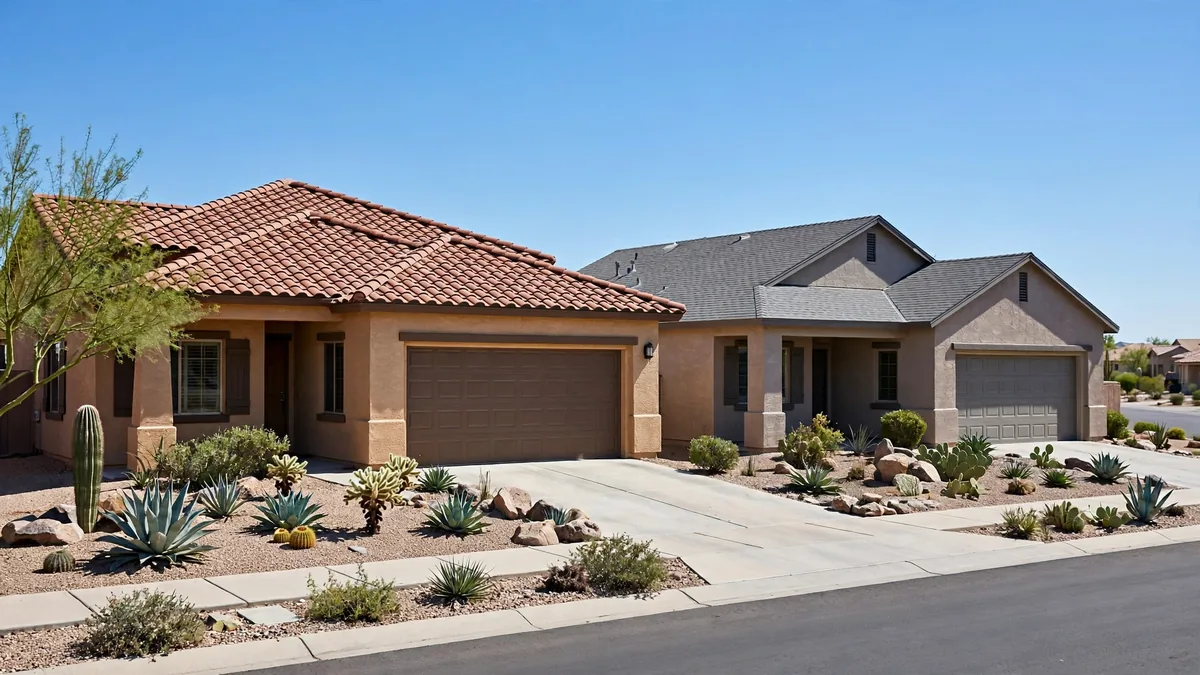
Drive any Phoenix street and the market has already voted: tile dominates the newer Valley, shingles hold the older neighborhoods and the budget end. Both are rational — for different owners. This comparison runs the numbers the Arizona way, because national comparisons get the two biggest variables (shingle lifespan and underlayment) wrong for the desert.
Tile vs shingle in Arizona: the comparison table
| Factor | Tile (concrete/clay) | Asphalt shingle |
|---|---|---|
| Installed cost per sq ft | $10–$18 | $2–$7 |
| Typical full job (Phoenix benchmarks) | $18,000–$35,000+ | ≈ $10,847 typical (Angi) |
| Service life in Arizona | 50+ yrs (clay 50–75) | 15–20 years |
| The hidden cycle | Underlayment every 20–40 yrs (avg job ≈ $3,400) | None — whole roof is the cycle |
| Cost per year of service (illustrative) | ≈ $450–$700/yr incl. one underlayment cycle | ≈ $550–$720/yr |
| Heat behavior | Ventilated channel; cooler attic | Direct-contact field; cool-granule options |
| Weight | Heavy (structural check to convert) | Light |
| Monsoon weakness | Shifted tiles, ridge caps, driven rain to underlayment | Lifted/peeling tabs at edges |
| Repair pattern | Many small fixes, rare big ones | Few small fixes, regular big one |
| HOA/architecture fit | Required in many Valley communities | Standard in older/infill areas |
Cost-per-year rows are illustrative midpoints from the linked cost guides, not quotes.
The lifespan math, honestly
Tile’s sales pitch (“50-year roof!”) and shingle’s (“30-year shingle!”) are both half-truths in Arizona. Tile really does last 50+ years — but as a system it needs its underlayment replaced at 20–25 years (felt) — call the real tile cost $24,000 once, plus ~$3,400–$5,000 once mid-life, across 50 years: roughly $550–$600 per year of service. Shingles really are cheap to buy — but in Phoenix they live 15–20 years (the shingle guide explains the heat chemistry), so $10,847 every ~18 years is roughly $600 per year — plus you buy the disruption twice more often. The crossover is your time horizon: under a decade in the home, shingles’ low entry price wins outright; past 25 years, tile pulls ahead and keeps going. The owners who lose are the ones who buy shingle math on a forever home, or tile math on a five-year stay.
Heat, weight and the practical differences
Tile’s ventilated profile is a genuine Phoenix advantage: the air channel under the tiles interrupts heat transfer to the deck, and desert-colored tile reflects well. Shingle technology fights back with reflective granules, but contact is contact. Weight cuts the other way: tile conversions need structural verification (see the FAQ), tile repairs demand technique (walking tile wrongly breaks it), and tile’s storm failure mode — a shifted field leaking into aging underlayment, per our monsoon guide — is subtler than shingles’ honest, visible peeling.
Which should you choose?
- Staying 20+ years, structure and HOA allow: tile, with a premium underlayment spec — the tile replacement guide has the bid details.
- Selling within 10 years or budget-bound: architectural shingles, the heaviest mat you can justify, with ventilation upgrades — buy desert years, not brochure years.
- Buying a home: price the roof that’s on it by its true remaining life — a 22-year-old tile roof needs a $3,400 line item, a 17-year-old shingle roof needs a $10,847 one — and negotiate accordingly with the inspection guide numbers in hand.
Either way, the maintenance rhythm is the same desert calendar — the Phoenix maintenance guide covers both systems season by season.
The factors people forget: noise, hail and insurance
Three second-order factors deserve a row in your decision. Noise: tile is quieter in monsoon downpours; rain on shingles over a deck is audible, and hail — rare but real in the Valley — is loud on both and damaging in different ways (tile cracks under big hail; shingles bruise and shed granules). Insurability: Arizona insurers increasingly price and underwrite by roof age and type. A documented tile roof with fresh underlayment is an underwriting asset for decades; a shingle roof starts drawing age questions in its teens. Owners have been surprised at renewal by the older roof — whichever system you choose, keep its paperwork current (dates, products, warranties) so the insurer sees the roof you actually own. Repairability by others: future trades — solar, satellite, HVAC — will walk your roof. Tile punishes careless feet with breakage bills; shingles forgive them. If your roof hosts frequent service visits, factor a tile-breakage allowance (or proper walkway pads) into the tile column honestly.
The bottom line for Phoenix homeowners
Choose tile when the horizon is long, the architecture fits and the structure allows — then treat the underlayment as the real roof and buy its best spec. Choose architectural shingles when the horizon is shorter or the budget is firm — then spend the savings on ventilation and the heaviest mat, and calendar the 15–20-year replacement from day one instead of discovering it. The wrong choice is rarely the material; it’s mismatching the material to the horizon. Run your own horizon honestly and both roofs are good roofs — the desert just keeps score differently than the brochures do.
Three ownership horizons, worked through honestly
The ten-year owner. If you expect to sell within a decade, the lower entry price usually governs. Architectural shingles at $2–$7 per square foot, with a typical Phoenix job around $10,847 on Angi’s figures, buy you a roof that should cover the whole stay if it is installed well and vented properly. Spending $18,000–$35,000+ on full tile for the same decade only makes sense if the neighborhood expects tile, the structure already supports it, or a buyer will clearly reward it. Otherwise, put the difference toward the heaviest shingle mat you can justify and keep the paperwork clean for the sale.
The twenty-five-year owner. This is where the comparison tightens. One shingle cycle may not cover the stay, because Arizona shingles live 15–20 years; you could be buying a second replacement, or selling with a roof already drawing age questions. Tile costs more up front at $10–$18 per square foot, but the tile itself is a 50+ year material, and the planned mid-life event is underlayment replacement — about $3,400 on average — rather than another full roof. At this horizon, get both bids on the same house and compare the full sequence, not just day-one price: shingle now plus a probable second shingle later, against tile now plus one underlayment cycle.
The high-country owner. Do not force the desert comparison onto a mountain house. In Flagstaff, Prescott, and the White Mountains, snow load and freeze change the specification, and architectural shingle or metal is often the practical system regardless of what wins in Phoenix. Tile’s weight and cold-weather behavior, and foam’s desert-flat-roof logic, do not transfer cleanly to a steep snow roof. The honest question there is not “tile or shingle?” but “which shingle specification, underlayment, and ice protection fit this pitch and climate?” Statewide context is in the Arizona replacement cost guide.
What does switching from one system to the other actually involve?
Changing material is never just changing the surface. Going from shingle to tile adds substantial weight — tile runs roughly two to four times heavier per square foot — so the structure has to be evaluated before the design conversation goes any further. If reinforcement is needed, price it as part of the conversion and ask whether it erases the long-horizon advantage you were buying. The job also brings a different underlayment decision, because under tile that membrane carries the waterproofing for the next 20–25 years on felt, longer on premium membranes.
Going from tile to shingle avoids the weight problem but raises different questions. Why is a 50+ year material being removed? If the answer is only that the underlayment has expired, a lift-and-relay usually deserves a bid beside the conversion, since it restores the waterproofing while keeping the tile. If the tile itself is eroded, discontinued beyond practical matching, or the architecture is changing, shingles may be rational — but confirm HOA rules, check how the change reads in a tile neighborhood at resale, and make sure removed tile disposal is line-itemed. Either direction, sequence solar with the change rather than around it: panels should not go back over a layer with a short remaining life. The upkeep consequences are spelled out in the Phoenix maintenance guide, and they differ enough by system to belong in the decision, not after it.
How we publish costs: every figure on this page is a range compiled from named third-party sources credited in the text (Angi, HomeAdvisor, the National Weather Service, the Arizona Registrar of Contractors and roofing-material references) — never a quote. Roofing prices move with material costs, roof size and access; the only number that matters for your house is a written bid from a licensed roofer.
Frequently asked questions
Which roof keeps a Phoenix house cooler, tile or shingle?
Tile, generally. Tile's shape creates a ventilated air channel between the tile and the deck, and lighter desert tile colors reflect more heat than a typical dark shingle field in direct contact with the deck. The effect shows up in attic temperatures and summer cooling load. Shingles improved with reflective 'cool roof' granules, but the physical air gap under tile is an advantage shingles can't copy.
Can I replace my shingle roof with tile?
Sometimes. Tile weighs roughly 2–4x more per square foot than shingles depending on profile, and many shingle-roofed homes were framed for the lighter load. A structural evaluation is mandatory, lightweight tile profiles exist for some cases, and HOA/neighborhood design rules may require or forbid tile. Get the engineering answer before falling for the look — retrofitting structure can erase tile's cost advantage.
Which roof is better with rooftop solar in Arizona?
Both work; the planning differs. On tile, solar mounts require tile hooks or removing/replacing tiles around mounts — skilled work, and you want the underlayment fresh before panels go on for 25 years. On shingle, mounting is simpler but the 15–20-year shingle life means panels will likely come off once for a re-roof. Either way: never put 25-year solar over a roof layer with 5 years left.
Do tile roofs need more maintenance than shingles in Phoenix?
Different maintenance, similar effort. Tile: periodic broken-tile swaps, ridge mortar care, debris clearing, and the one big underlayment event per generation. Shingles: tab repairs, sealant-strip aging, granule monitoring, and full replacement on a 15–20-year rhythm. Foam-free, both are covered on our maintenance calendar. The tile roof's maintenance is cheaper per decade; the shingle roof's is simpler to DIY at the margins.
Which roof do Phoenix buyers prefer at resale?
In tile neighborhoods, a tile roof — it's the expected architecture and a 50-year material reads as 'done' to buyers and insurers. In shingle neighborhoods, a *newer* shingle roof reads the same way. The losing hand in either market is the roof at end-of-life during the sale: concessions, certification demands and insurance friction. Condition and documentation beat material in the negotiation room.