Monsoon Roof Damage: What AZ Storms Do to Your Roof
Every Phoenix homeowner knows the rhythm: a wall of dust at dinner time, twenty minutes of violent wind, rain coming in sideways — and then, a day or two later, a brown ring spreading across a ceiling. Monsoon roof damage follows patterns, and once you know them, most of it stops being surprising.
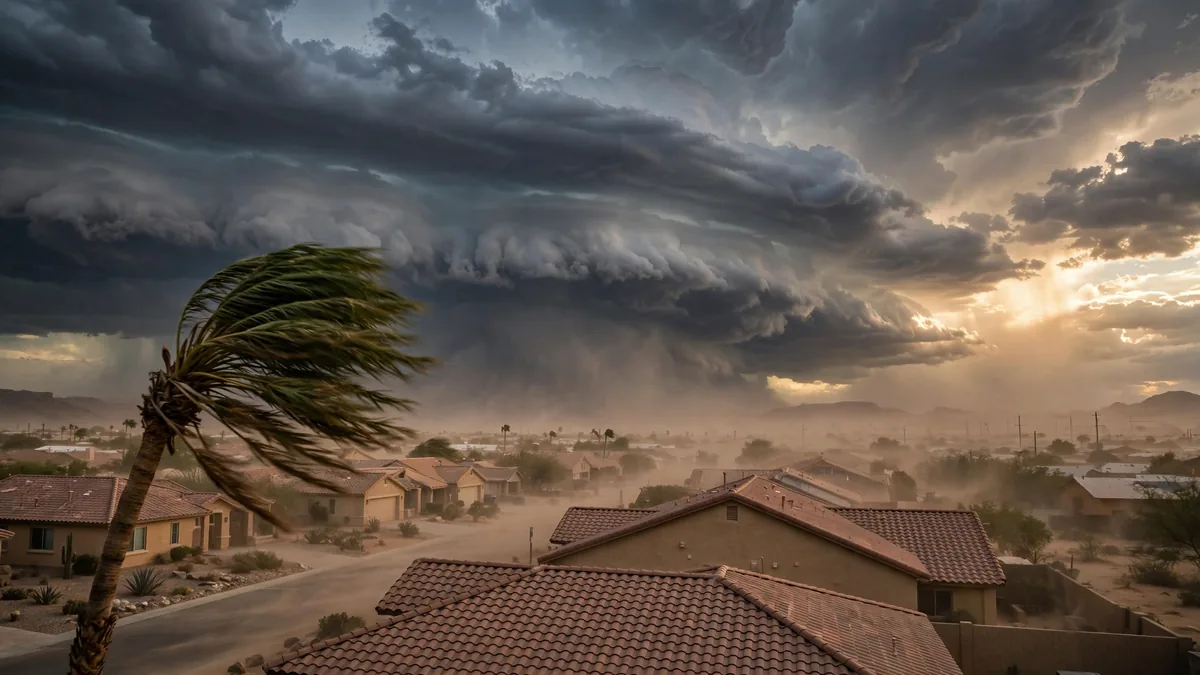
Every Phoenix homeowner knows the rhythm: a wall of dust at dinner time, twenty minutes of violent wind, rain coming in sideways — and then, a day or two later, a brown ring spreading across a ceiling. Monsoon roof damage follows patterns, and once you know them, most of it stops being surprising.
What is a monsoon storm, in roof terms?
The National Weather Service sets Arizona’s monsoon season as June 15 through September 30. For your roof, the season delivers four distinct weapons:
| Storm feature | What it does to a roof |
|---|---|
| Microburst / downburst winds | Sudden gusts (severe threshold 58 mph, microbursts much higher) that lift tiles, ridge caps and shingle edges — especially anything already loose |
| Wind-driven rain | Rain pushed uphill and sideways: under tile laps, into wall and vent flashing, past defenses designed for vertical rain |
| Haboobs (dust storms) | Valleys, gutters and flat-roof drains packed with dust and debris; grit abrasion on foam coatings; debris that cracks tile |
| Repeated soaking cycles | Water ponding behind debris dams and on flat sections, finding every crack in aged underlayment, week after week |
What does monsoon season do to a tile roof?
Tile’s monsoon enemies are movement and driven water. Gusts walk poorly-fastened tiles out of position and snap the mortar or foam pads holding ridge caps; a shifted tile is both a leak path and a projectile risk for the next storm. Driven rain gets under the tile field and tests the underlayment — which, on a 20–25-year-old Phoenix roof, is often the brittle felt we describe in the underlayment guide. The storm didn’t create that failure; it invoiced it. Cracked tiles from wind-blown branches and patio furniture complete the list.
What does it do to shingle and foam roofs?
Shingles fail at their edges: heat-aged shingles lose flexibility and adhesive bond, so monsoon gusts peel tabs and rows, starting at rakes and ridges. Once a row lifts, the next storm takes it. This is the main reason the 15–20-year Arizona shingle lifespan in our tile vs shingle comparison matters more in July than in January.
Foam (SPF) roofs — the flat-roof standard in Phoenix — resist wind well because they’re seamless and adhered, but they hate punctures and neglected coatings. Blown debris cuts the elastomeric coating; UV then degrades the exposed foam; ponded water behind a clogged scupper sits on the damage for weeks. A foam roof whose recoat cycle has been skipped (see foam roof costs) enters monsoon season with its armor already cracked.
The morning-after inspection (from the ground)
- Walk the perimeter. Tiles, shingle tabs or ridge pieces on the ground are a head count of what the roof lost.
- Look up at ridges and edges. Gaps in the ridge line, a cap sitting crooked, a lifted eave row.
- Check ceilings and the attic. Fresh stains, damp insulation, daylight where there shouldn’t be. Photograph everything with timestamps — this is your insurance record.
- Clear the drainage you can reach safely. Gutters, scupper mouths and valley bottoms from a ladder at the eave — never by walking a wet roof.
- Tarp logic. If water is actively entering, a professionally installed tarp beats a DIY climb. Emergency tarping and repair are priced in our monsoon damage repair guide.
What should you do before the next storm, not after?
The entire damage pattern above has a flip side: nearly all of it is cheaper to prevent in May than to repair in August. Loose ridge caps get re-set, cracked tiles get swapped, debris gets cleared, foam coatings get checked, and the underlayment question gets answered while the roof is dry and roofers have open calendars. That’s the whole logic of the pre-monsoon roof inspection checklist — ten items, most free.
And if the storm already came and you’re staring at a stain: start with what monsoon repairs cost, then read whether insurance covers it before you call either number. The order matters: document first, claim second, sign last.
How the damage pattern shifts across the season
June storms are wind events — the season opens with dry microbursts and haboobs before the moisture arrives, so early-season damage skews to lifted tiles, ridge caps and debris. July and August are the rain months, when driven-rain leaks and drainage failures dominate and the weaknesses June loosened start admitting water. September storms are fewer but ride on a roof that has already taken two months of cycling — the late-season leak on a roof that “survived July fine” is usually cumulative: debris that migrated, mortar that finally let go, underlayment laps that worked open storm by storm. Practical consequence: the mid-season check matters. A quick ground-and-attic pass in early August catches the June damage before the September rain does.
The collateral pattern: patios, pools and trees
Monsoon damage reports in Phoenix follow the yard, too. Patio and carport roofs (often the home’s foam or rolled-roofing sections) take the debris and the ponding. Pool equipment areas collect wind-blown tile fragments — check the deck and the pool before the pump eats a shard. Trees are both victim and weapon: mesquite and palo verde limbs that overhang the roof become battering rams in outflow winds, and the same storm that drops a limb on your tile field drops your neighbor’s limb on theirs. The maintenance calendar keeps tree clearance on the May list for this reason. Photograph collateral damage with the roof damage — adjusters process one storm file more kindly than three separate stories.
How does a single monsoon cell damage a roof in sequence?
A typical damaging cell does not apply all its forces at once. The outflow arrives first — a sudden wind shift and gusts that lift loose ridge caps, work at shingle edges, and shift tiles that were already out of position. Dust and debris come with that front, filling valleys and drainage paths and scattering grit and branches across the roof.
Rain follows, often driven at an angle by the same wind. By that point the drainage may already be partly blocked and a tile or flashing detail may already be open. Water that would have shed cleanly in a calm rain now ponds behind debris, runs sideways at wall junctions, and gets pushed under laps. The damage homeowners find later is often the result of that order: wind opens and clogs, then driven rain exploits both.
Understanding the sequence explains why two neighboring houses can come through the same storm differently. A roof that entered the cell with clear valleys and secure ridge work may shed both phases. A roof with one loose detail can collect damage out of proportion to the storm’s headline wind speed.
Which damage shows up late, and why?
Not every monsoon problem announces itself the next morning. A cracked tile with intact underlayment underneath may admit no water until a later storm drives rain at the right angle. Debris that was washed partway into a valley during one cell can complete its dam during the next. Sealant or mortar loosened by one round of wind and thermal movement may hold through a light rain and fail in a heavier one.
Foam and flat sections have their own delayed pattern. A coating cut by debris does not leak immediately if the foam beneath is still sound; it degrades as UV reaches the exposed material and as ponded water sits on the spot. Weeks later, the symptom appears at a ceiling, far removed in time from the storm that started it.
That delay is why the mid-season ground and attic check matters, and why the post-season pass in October finds work that July and August inspections missed. For what those delayed findings usually cost to fix, see monsoon roof damage repair; for preventing them in the first place, the pre-monsoon roof inspection checklist is the May version of the same work.
How we publish costs: every figure on this page is a range compiled from named third-party sources credited in the text (Angi, HomeAdvisor, the National Weather Service, the Arizona Registrar of Contractors and roofing-material references) — never a quote. Roofing prices move with material costs, roof size and access; the only number that matters for your house is a written bid from a licensed roofer.
Frequently asked questions
When is monsoon season in Arizona, officially?
The National Weather Service defines Arizona's monsoon season as June 15 through September 30 — fixed calendar dates adopted in 2008, replacing the old dewpoint-based start. Storms cluster in July and August, but damaging wind and dust events happen at the season's edges too, which is why pre-season roof checks happen in May and early June.
What wind speed damages a roof in Phoenix?
Severe thunderstorm warnings start at 58 mph gusts, and microbursts can exceed that by a wide margin in a small area. A sound, well-fastened roof handles those gusts; a roof with loose ridge caps, cracked mortar, lifted shingle edges or degraded foam coating starts shedding pieces in the 50–70 mph range. Damage is less about the number than about the roof's weakest detail.
Why did my roof leak in a storm but not in normal rain?
Because monsoon rain doesn't fall — it's driven. Wind pushes rain uphill under tile laps, sideways into wall flashing and vents, and ponds it behind debris dams in valleys. A roof can be watertight against vertical winter rain for years and leak in the first hard monsoon cell. The leak path is usually a flashing or underlayment weakness the storm exposed, not a hole the storm made.
Does a haboob damage roofs?
Mostly indirectly. Haboob dust and debris fill valleys, gutters and flat-roof drains, setting up ponding and overflow in the rain that follows. Wind-blown debris can also crack tiles and puncture foam coatings. The post-haboob job is cleaning drainage paths — which is a line item on our pre-monsoon checklist — before the next cell arrives.
Should I get on the roof right after a storm to check?
No — check from the ground and the attic. From the ground: look for tiles on the lawn, shifted ridge caps, hanging debris and stained patio ceilings. In the attic (in the cool morning): look for daylight, fresh water staining and damp insulation. Walking a wet, storm-loosened tile roof breaks more tiles and risks you. Photograph what you find for insurance, then call a licensed roofer for the close look.